Modular Habitats

DEPLOYABLE LIFE-SUPPORT & INDUSTRIAL HABITATION

MODULAR HABITATS

Modular Habitats engineers buildings as deployable envelopes. A habitat is not real estate — it is a sealed envelope around water, air, food, power, thermal stability, sanitation, and communications. The flagship product line spans three deployment classes (the MH-Orbital for vacuum service, the MH-Lithic for surface service, the MH-Subterra for sheltered or below-ground service) and shares a common utility spine that integrates Polymer Press skins, Phase Flash water systems, Matter Kitchen appliances, Foundation Kinetics assembly, and (in the future) Stellar Furnace compact power.

Conventional construction is slow, site-specific, labour-heavy, and infrastructure-dependent. Modular Habitats inverts every one of those: a habitat is factory-built, site-agnostic, robotically assembled in the field, and infrastructure-free. The constraint-collapse concept is “one-cycle deployment”: from container delivery to occupied service in a single staged sequence measured in hours rather than months.

Modular Habitats — Deployable Life Support and Industrial Habitation

A habitat is the engineered envelope between an occupant and an environment. We build that envelope as a product, not as construction.

01 — The Discipline

An engineered habitat is a sealed envelope that maintains specified interior conditions against unspecified exterior conditions. Interior conditions include the obvious (breathable atmosphere, drinkable water, food storage and preparation, sanitation, thermal comfort, electrical power, light, communications) and the less-obvious (humidity, particulate filtration, biological contamination control, structural integrity against wind / earthquake / impact, electromagnetic shielding where required). Exterior conditions span vacuum to undersea pressure, sub-Kelvin cold to desert heat, sterile to biologically active. The discipline is engineering the envelope so the interior is decoupled from the exterior across all of these axes.1

The product is not the structure; the product is the operating envelope it delivers. A Modular Habitats deliverable specifies the interior conditions it maintains, the exterior conditions it survives, the occupancy it supports (number of people, duration, activity level), the deployment time, the power draw, the consumables required, and the service interval. Two habitats with identical floor plans can be different products if their envelope specifications differ — one rated for tropical service is engineered differently from one rated for high-altitude polar service even when both look identical from the inside.2

The deployable-envelope framing turns construction into manufacturing. The factory builds the envelope to specification; field deployment installs it. The labour required at the deployment site collapses to a small crew (often a single Foundation Kinetics Arachne-class robot plus an operator) and an installation time measured in hours instead of weeks. The capital efficiency of the platform comes from this collapse: the habitat is built once, in a controlled factory environment, then deployed many times at sites that would conventionally each require months of on-site construction.

02 — The Bottleneck

Conventional building construction is slow because every site is treated as a unique problem. Permits, foundations, materials sourced locally, on-site labour, weather delays, utility hookups, regulatory inspections — each is a sequential gating step measured in weeks to months. The total time from site identification to occupancy on a small commercial structure is six months in the developed world and longer in resource-constrained regions. The capital cost reflects this sequencing: most of the cost is labour and time, not material.3

The deeper bottleneck is infrastructure dependence. Conventional habitation assumes municipal water, sewer, grid electricity, and access roads. Sites without these — remote industrial outposts, disaster-relief deployments, off-grid research stations, mobile bases — require the habitat to bring its infrastructure with it: a water plant, a wastewater system, a generator or battery, a fuel supply chain. The cost and complexity of these supporting systems often exceed the cost of the habitat structure itself, and their failure modes set the operational reliability of the whole installation.4

The Modular Habitats thesis is that infrastructure can be integrated into the habitat envelope. A habitat that includes its own water-purification (Phase Flash Oasis), its own food-preparation (Matter Kitchen), its own thermal management (Polymer Press insulation + active heat pumps), and its own power (battery, photovoltaic, future Stellar Furnace) is not a building with utility hookups; it is a self-contained service envelope. The deployment site only has to be a clear, level surface (or a clearable, levelable surface for the Arachne-class field assembly variant). The site-specific engineering collapses to logistics.

03 — The Habitat Envelope

The flagship product line ships three deployment classes, each engineered against a distinct exterior-condition envelope:

MH-LITHIC — SURFACE DOMAIN

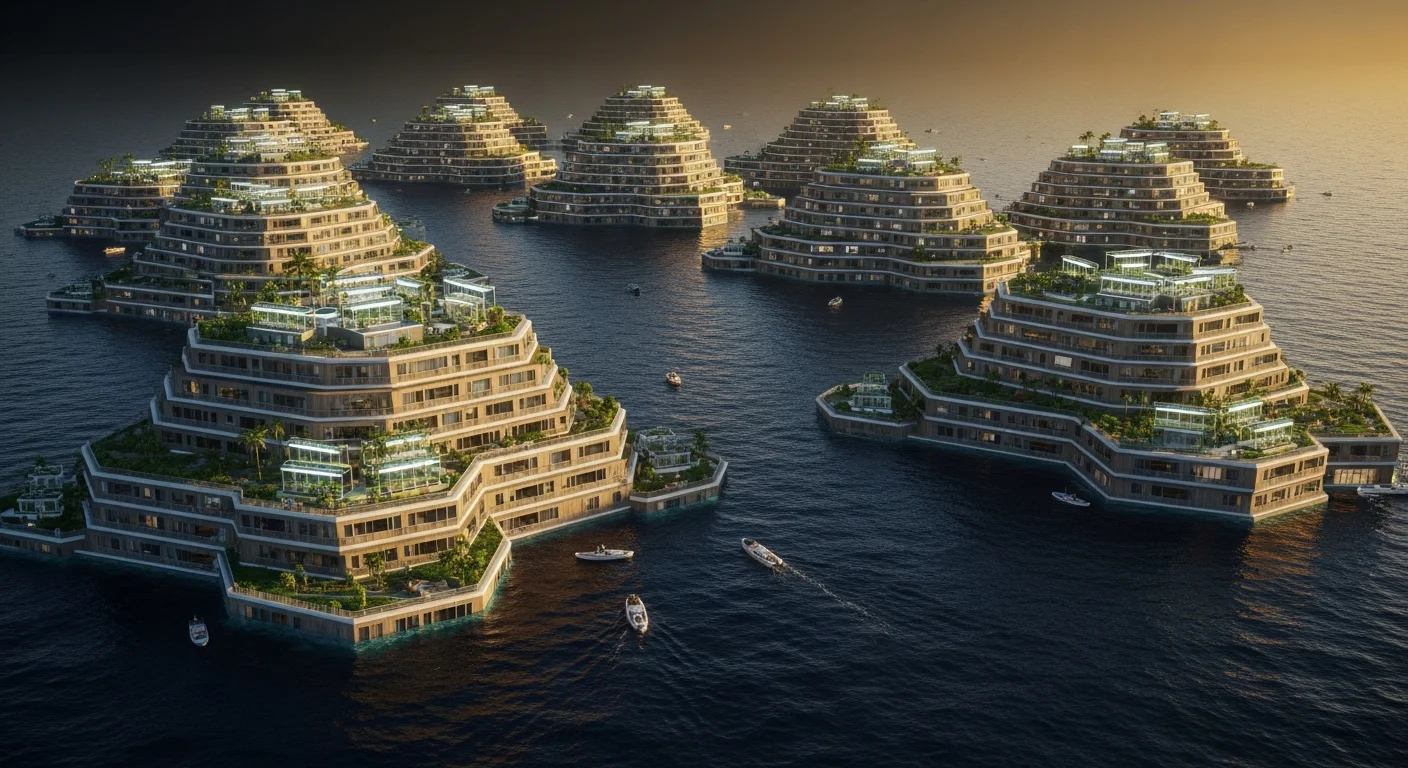
Standard surface-deployment class. Single-storey footprint approximately 8×12 metres, occupancy four to twelve persons, designed for sustained service from sub-Arctic to tropical climates. Polymer Press composite outer skin over an insulated structural cage; Polymer Press foam core for sub-zero-rated thermal isolation; integrated Phase Flash water subsystem (10 L/hr drinking-grade from any saline or fresh source); Matter Kitchen pod-based food appliance; battery + photovoltaic power. Field-assembly time approximately eight hours with a Foundation Kinetics Arachne-7 weaver + two-person operator crew.5

MH-SUBTERRA — SHELTERED & BELOW-GROUND

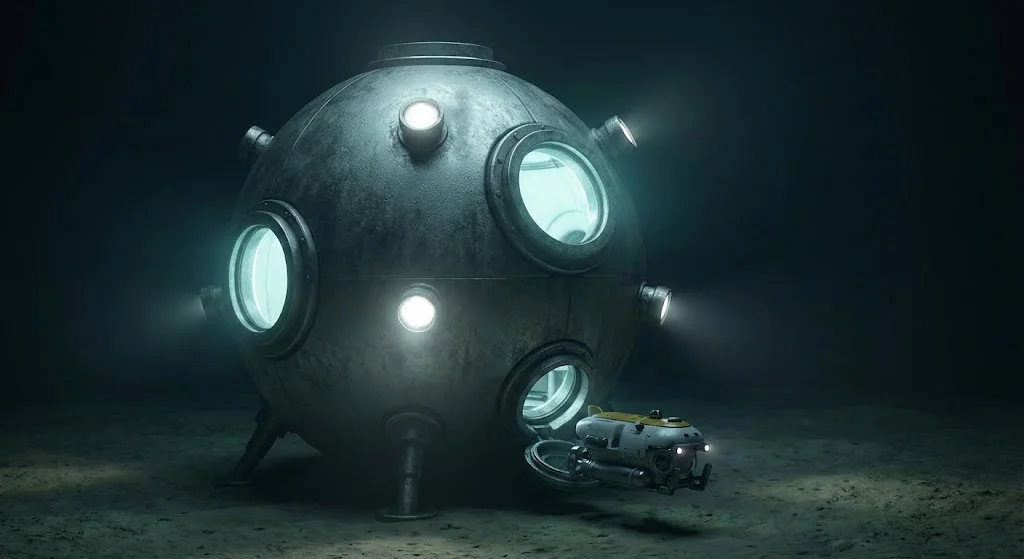
Variant for sheltered, mountainside, or shallow below-ground service. Mass tradeoff vs MH-Lithic: heavier-gauge structural skin for impact and overburden loading; reduced photovoltaic, increased battery + grid-tie or generator integration; cooling-dominant thermal envelope (the local exterior is closer to constant temperature than open surface); EMP-resistant communications spine. Designed for sustained-service applications where the exterior environment is mechanically stable but the operating site is remote: research stations, monitoring outposts, secure storage, communications relay.

MH-ORBITAL — VACUUM SERVICE

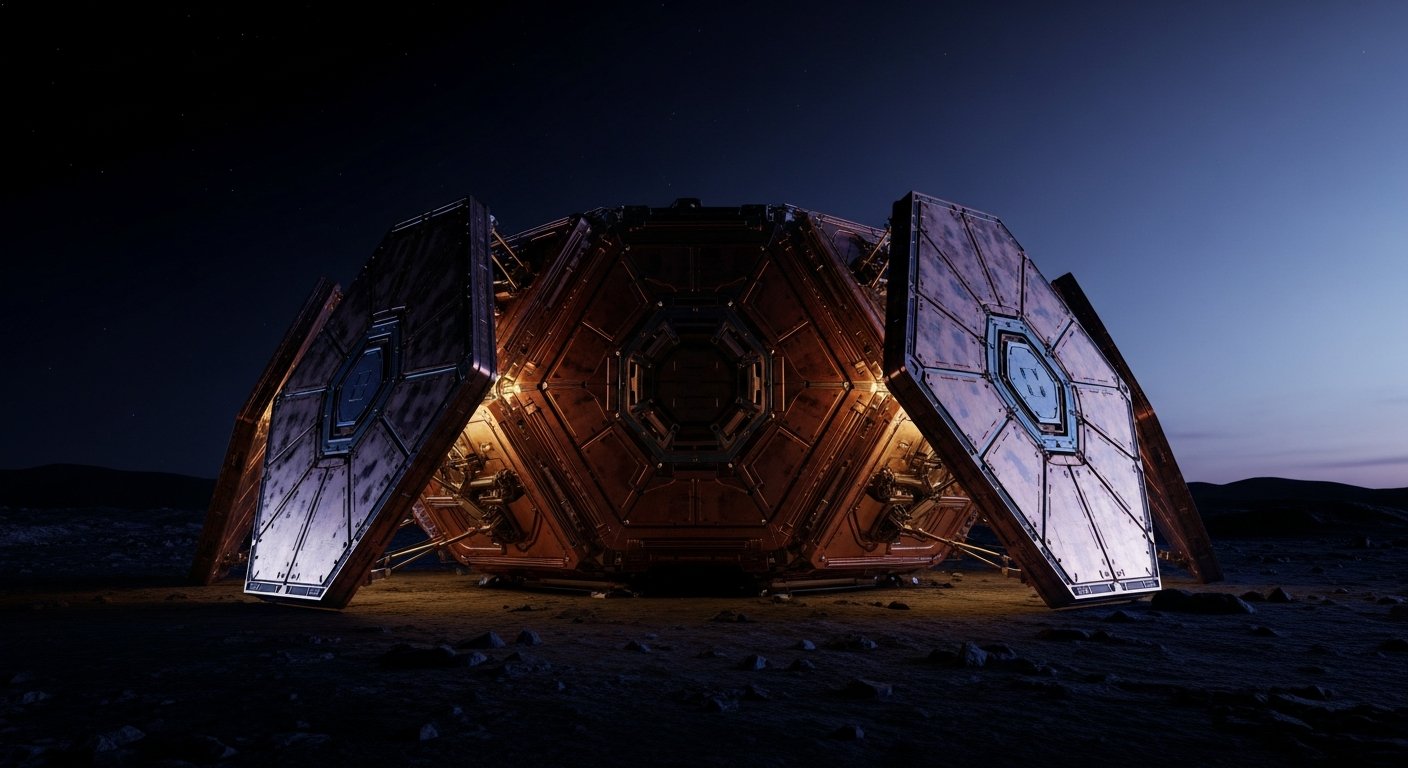
Long-horizon research target for vacuum-rated habitation. Pressurised inner shell rated for sustained 100 kPa internal pressure against vacuum exterior; multi-layer insulation against thermal cycling; radiation-shielding overlayer (Metallic Sciences refractory + polymer composite stack); life-support recycling for water and atmosphere (closed-loop). Engineering target rather than production product; the program depends on multiple maturation cycles in the MH-Lithic and MH-Subterra platforms before the MH-Orbital variant is meaningful.6

MH-LITHIC FOOTPRINT~8×12 m single-storey, 4-12 occupants
MH-LITHIC DEPLOYMENT~8 hr field assembly, 2-person + Arachne-7 crew
MH-LITHIC THERMAL-40°C to +50°C exterior rated, ±5°C interior control
MH-LITHIC POWER5 kW PV + 50 kWh battery, optional grid/generator tie
WATER10 L/hr Phase Flash Oasis-integrated, 99.95% salt rejection
FOODMatter Kitchen pod-based volumetric cooking appliance
MH-SUBTERRA EMP-RESFaraday-cage composite skin, EMP-rated comms spine
MH-ORBITAL TARGETVacuum-rated, closed-loop air+water, fn-theoretical
THREE DEPLOYMENT CLASSES  //  LITHIC (surface) · SUBTERRA (sheltered) · ORBITAL (vacuum, research target)

04 — Life-Support Stack

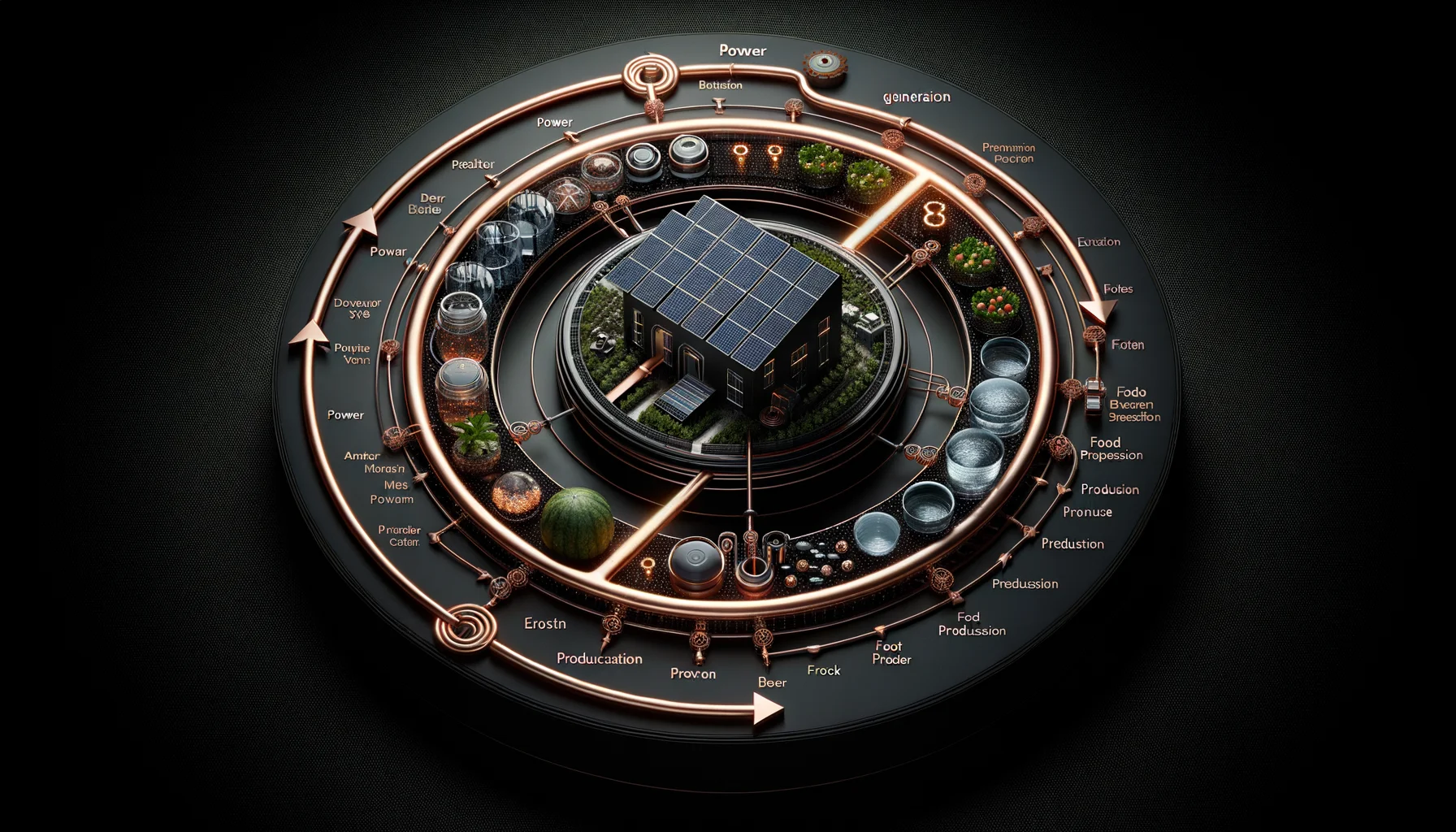
The integrated life-support spine is the engineering core of every habitat variant. Seven subsystem layers are engineered as products in their own right and integrated through a shared mechanical and data backbone:

WATERPhase Flash Oasis Field Unit; 10 L/hr drinking-grade from any feed; closed-loop greywater on MH-Orbital variant
AIRHEPA + activated-carbon filtration; humidity 35-60%; CO₂ scrubbing for sealed-service variants
FOODMatter Kitchen volumetric cooking appliance; refrigerated pod cassette for 30-day cycle
WASTEComposting toilet (lowest-power); incinerating variant for sterile-environment requirements
POWER5 kW PV + 50 kWh LiFePO₄ battery; optional grid-tie; future SF-1 compact-fusion power option (research target)
THERMALPolymer Press closed-cell foam insulation; reversible heat pump (heat or cool); passive solar shading per orientation
MONITORINGContinuous sensor suite (T/RH/CO₂/VOC/power/water-flow/door-state); local Aetheric edge compute; alert escalation to operator
COMMSSatellite + cellular dual-stack; mesh-radio extension for site-cluster deployments
SEVEN SUBSYSTEM LAYERS  //  ENGINEERED AS PRODUCTS  //  INTEGRATED THROUGH SHARED BACKBONE

Subsystem failure modes are designed in. The water subsystem can run from battery for 24 hours while the photovoltaic recovers from a multi-day weather front. The food subsystem keeps a 30-day pod inventory at any deployment. The thermal subsystem can hold interior temperature for 12 hours with all active heating off (passive insulation alone). The monitoring spine continuously logs every subsystem's state; if a subsystem degrades below specification, the alert escalates to the operator with diagnostic context. Routine maintenance is a swappable-cassette model: water filters, air filters, food pods, battery modules are individually replaceable in minutes without service interruption.

05 — Deployment and Assembly

The MH-Lithic field-assembly sequence is the constraint-collapse demonstration of the platform. A shipping container delivers the disassembled habitat: factory-built structural cage in ten panels, factory-assembled utility spine in two modules, factory-rolled outer skin in one folded sheet, factory-stocked life-support subsystems in two cassettes. A Foundation Kinetics Arachne-7 weaver positions and bonds the structural panels under the operator's supervision; the utility spine drops in as a single assembly; the outer skin is tensioned and bonded to the structural frame; the life-support cassettes slide into their bays. Total field-assembly time: approximately eight hours from container offload to occupied service.7

The one-cycle deployment concept is the operational specification: the habitat is occupied within a single daylight shift of container arrival. Conventional construction’s critical-path activities (foundation curing, weather-dependent envelope completion, utility hookup) are eliminated by design: the structural footprint is a levelled-gravel pad rather than a poured foundation; the envelope arrives factory-sealed; the utilities are integrated rather than hooked-up.

Logistics integration with Fermat Logistics is the upstream of the deployment loop. A single MH-Lithic ships as a 40-foot ISO container (Sigma-1 standard cargo class). The MK-Oasis humanitarian-deployment programme co-runs Phase Flash Oasis Field Units in the same logistics envelope: water can be delivered ahead of habitat, or habitat with water, or paired with food in a coordinated sequence. The shared sigma-class spec across the supplier network is what makes coordinated deployment possible.

Repair and field-modification are designed-for. A Foundation Kinetics Scarab-class compact actuator suite ships with every operator team for in-field service: structural-skin patch placement, utility-spine module swap, life-support subsystem replacement. The habitat is engineered to remain occupied during routine repair; only safety-critical structural work requires temporary evacuation. Modular expansion (multiple MH-Lithic units bonded into a larger contiguous footprint) uses a separate factory-built interconnect kit; expansion is a deployment event rather than a construction event.

06 — Supplier & Integration Partners

Modular Habitats is the integration point of the substrate stack. Its product lines depend on technology from eight peer companies; the integration is the engineering work that distinguishes the platform.

Polymer Press — Interior panel substrate, structural-skin composite, foam wall cores, vapour-barrier membranes, closed-cell foam thermal isolation rated for sustained sub-zero outdoor service.

Phase Flash — Oasis Field Unit (two-litre-per-hour battery-powered desalination) integrated as the water-subsystem core. Standard inclusion across all three habitat classes.

Matter Kitchen — Volumetric-cooking appliance integrated as the food-subsystem core. Refrigerated pod cassettes designed to interoperate with the habitat's power and storage envelope.

Foundation Kinetics — Arachne-7 weaver for field-assembly of the structural cage; Scarab-class compact actuators for in-field repair and modular expansion.

Highfield Magnetics — Iso-Field-class precision magnets for industrial-instrumentation habitats (research stations equipped with on-site NMR or precision measurement equipment).

Stellar Furnace — Future compact-power option (SF-1 derivative) for habitats where photovoltaic + battery is insufficient or unavailable. Engineering-program horizon; not in current product configurations.8

Aetheric Sciences — Edge-compute platform for the monitoring spine. Operator-state and subsystem-state log analysis. Alert-escalation logic.

Fermat Logistics — Container-class transport for habitat deployment. MK-Oasis humanitarian-deployment programme coordination. Sigma-1 standard-cargo handling.

Metallic Sciences — Structural-cage alloy stock (corrosion-resistant high-entropy alloy for the MH-Lithic variant). Refractory + radiation-shielding overlayer for the MH-Orbital research-target variant.

Polymer Press → Phase Flash → Matter Kitchen → Foundation Kinetics → Highfield Magnetics → Stellar Furnace → Aetheric Sciences → Fermat Logistics → Metallic Sciences →

07 — Validation Hooks

Five measurable claims define the forward roadmap. Each is intended to be a future Crystal Ball-grade prediction registration once the prediction infrastructure exists.

HOOK A — field-assembly time. Current MH-Lithic field-assembly time is approximately eight hours. The forward target is four hours, achieved through tighter Arachne-7 process automation and pre-tensioned skin assembly. The gating measurement is a documented two-person field deployment to four-hour occupied-service-ready milestone, on a representative greenfield site, in representative weather, with a representative crew.9

HOOK B — water recovery ratio in closed-loop variant. The MH-Orbital research-target variant requires closed-loop water recovery to be sustainable in vacuum service. The current laboratory demonstration of integrated Phase Flash + greywater recovery achieves approximately 90 percent water recovery; the forward target is 98 percent. The gating measurement is a 90-day closed-loop operational test in a representative habitat fixture with simulated occupant loading.10

HOOK C — energy per occupant-day. Current MH-Lithic energy budget is approximately 3 kWh per occupant per day for standard subsistence service. The forward target is 1.5 kWh per occupant-day, achieved through tighter thermal-envelope engineering and DC-direct integration of major appliances. The gating measurement is a sustained 30-day operational test at the lower budget with documented operator-satisfaction parity.

HOOK D — maintenance hours per occupant-month. Current operator-facing maintenance hour budget is approximately four hours per occupant-month (filter swaps, log review, subsystem-state check). The forward target is one hour per occupant-month, achieved through better predictive monitoring and longer-cycle consumables. Demonstration is a 12-month accumulated maintenance log across a representative fleet of deployed habitats.

HOOK E — payload mass per habitable cubic metre. Current MH-Lithic payload-mass-per-cubic-metre is approximately 250 kg per cubic metre of interior habitable volume (skin + structure + utility spine + consumables). The forward target is 150 kg per cubic metre, achieved through tighter Polymer Press composite skin engineering and Metallic Sciences high-entropy alloy structural members. Demonstration is a redesigned MH-Lithic variant shipped at the lower mass while maintaining service envelope.11

RESEARCH REPOSITORY

Modular construction, closed-loop life support, water recovery, microgrids, robotics-assisted assembly, and engineered envelope materials.

Modular Habitats is the engineering of deployable life-support envelopes. The discipline collapses the conventional construction sequence by manufacturing the habitat as a product, integrating its infrastructure (water, food, power, thermal, comms) into the envelope itself, and shipping field assembly as a one-cycle deployment operation. Three deployment classes — MH-Lithic (surface), MH-Subterra (sheltered), MH-Orbital (vacuum research target) — share the same utility spine and substrate-supplier integration.

Reference Links — Modular Construction & Deployable Structures

(wiki) Modular Building  •  (wiki) Prefabrication  •  (wiki) Container Architecture  •  (wiki) Deployable Structure

Reference Links — Life Support & Closed-Loop Systems

(wiki) Life Support System  •  (wiki) ECLSS  •  (wiki) Closed Ecological System  •  (wiki) Water Recycling

Reference Links — Microgrids & Off-Grid Power

(wiki) Microgrid  •  (wiki) Stand-Alone Power System  •  (wiki) Photovoltaics  •  (wiki) LiFePO4 Battery

Reference Links — Materials & Envelope Engineering

(wiki) Building Envelope  •  (wiki) Insulated Panel  •  (wiki) Vapor Barrier  •  (wiki) Cold-Climate Construction

Bibliography
  1. Lawson, M. et al. Design in Modular Construction. CRC Press, 2014. ISBN 978-0-415-55450-3.
  2. Wieland, P.O. Designing for Human Presence in Space: An Introduction to Environmental Control and Life Support Systems. NASA RP-1324, 1994.
  3. Eckart, P. Spaceflight Life Support and Biospherics. Springer, 1996. ISBN 978-0-7923-3938-9.
  4. IEEE Std 1547 Standard for Interconnecting Distributed Resources with Electric Power Systems. 2018.
  5. ASHRAE Handbook of HVAC Applications. 2019 Ed.
Key Papers
  1. Bell, L.S. "Habitability and architectural considerations for living in space and on the Moon." Acta Astronautica 62, 102–113 (2008).
  2. NASA-STD-3001 NASA Space Flight Human-System Standard. 2014.
  3. Lin, J. et al. "Robotic assembly of modular space habitats." Proc. IEEE ICRA 2022.
  4. Williams, K. Off-Grid Solar. 2nd Ed. New Society Publishers, 2017. ISBN 978-0-865-71845-5.
Endnotes
  1. Envelope-as-product framing: standard building-science principle. The ECLSS literature is the closest established engineering vocabulary.
  2. Operating-envelope-as-deliverable framing: program engineering choice; standard product-engineering practice applied to habitation.
  3. Conventional construction sequencing: documented across the construction-industry literature. Six-month small-commercial-build cycle is typical.
  4. Infrastructure dependency of conventional habitation: standard observation. Off-grid systems carry their own infrastructure and the failure modes set operational reliability.
  5. MH-Lithic 8-hour field-assembly: engineering program target. Constituent technologies (Arachne-7 assembly, pre-tensioned skin, factory-built spine) are individually mature; integrated assembly at this cadence is the engineering work.
  6. MH-Orbital vacuum-rated variant: theoretical extrapolation. Vacuum-rated habitation is decades-mature space-engineering practice; the Modular Habitats integration into a deployable product is research target.
  7. One-cycle deployment operational specification: program goal. Constituent activities are well-bounded; sequencing into a single occupied-service-ready milestone is the engineering scope.
  8. Stellar Furnace compact-power integration: forward-looking theoretical extrapolation. SF-1 program success is the gating prerequisite (see Stellar Furnace).
  9. Four-hour field assembly target: engineering target; halving current assembly time via tighter Arachne-7 automation.
  10. 98 percent closed-loop water recovery: theoretical extrapolation from current 90% laboratory demonstration. Long-duration operational testing is the gating measurement.
  11. Payload mass per cubic metre target: engineering program. Material substitution + structural reengineering is the open work.